Showing posts with label Buddhist. Show all posts

Wednesday, February 16, 2011

Stupa to Pagoda 5: Fogang Si Pagoda (3-23)

Useful cultural background:  The Song Dynasty in China (Columbia University) LINK
Wikipedia article: Pagoda LINK
Wikipedia article: Architecture of the Song Dynasty: LINK
Wikipedia article: Pagoda of Fogong Temple LINK
Wikipedia article: Ancient Chinese Wooden Architecture LINK
"The Eight-Sided Pagoda of Foguang Si at Yingxian" by Kate Erickson LINK
Some Photos at Flickr HERE and HERE
Wikimedia page: Pagodas in China LINK


Monday, February 14, 2011

Stupa to Pagoda 3: Chaitya Hall at Karle (cf. 1-14)


Halls like this one at Karle and the ones at Ellora and Ajanta are carved out of hillsides.  All the interior elements are integral to the cave -- meaning that they are not built separately and set into the cave, but entirely carved out of the living rock.  The hall leads back to a stupa.

overview notes of the period from the Dept. of Architecture at UC Berkeley
descriptive entry at Chaitya.com
entry at Great Buildings Online


Stupa to Pagoda 2: More About Stupas


Miniature Stupa (Ashmolean Museum)


Miniature Japanese Stupas (British Museum)


Thursday, February 10, 2011

Yet More Buddhas beyond India (examples in textbook)

(2-11) Walking Buddha
Sukhothai, Thailand
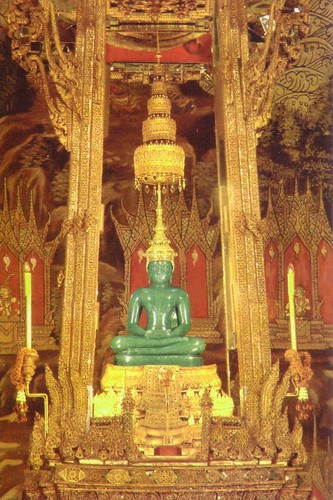
(2-12) Emerald Buddha
Wat Phra Kaew
Bangkok, Thailand
(3-28) Shakyamuni Buddha
Sokkuram, Korea

(3-11) Shakyamui Buddha
Hebei China, Zhao dynasty

More Buddhas beyond India

Buddha (Tibet, 1700-1800)
  
OK, so we've looked at early representations of the Buddha (from Gandhara) and we've looked at a later example (from Sarnath) which shows the early form refined into a classic formula.  Now it's time to consider how that classic formula gets taken up & refined by different cultures, outside India.  


Buddha (Korea, AD 900-1100)
We should keep in mind that, while the Buddha is in some sense a representation of an abstract ideal, the Buddha is also a specific material subject.  In Africa we looked at how different cultures portrayed similar abstract ideals (kingship, power, the relationship between men and women, the ideal child) but always through subject matter that varied from specific culture to specific culture.  The Buddha is a subject matter than can "belong" to any people.  The Buddha crosses all boundaries.   

Buddha (Thailand, 14th c.)
 The Buddha is not just art from the world; the Buddha is art of the world.  There are many peoples, many forms of Buddhas, many styles of Buddhas, many Buddhas, but at the same time, all Buddhas are one.


Article on "Buddhism and Buddhist Art" at the Metropolitan Museum of Art
Article on "The Art of Buddhism" at the Smithsonian Institution
Some different examples of Buddhas
A Chinese Buddha (late 7th-early 8th century)
Another Chinese Buddha (7th century)
A Tibetan Seated Buddha (9th-10th century)
A Buddha from China (early 11th century)
A Buddha from Thailand (16th century)
The Emerald Buddha in Bangkok
A Sukhothai Walking Buddha
Many Buddhas in Baltimore
Perfection in the proportions of a Buddha (BuddhaNet)

Tuesday, February 8, 2011

Another Teaching Buddha from Sarnath

From the British Museum, London.  Photos by yrs truly.


Teaching Buddha from Sarnath (1-13)


Note the lakshanas seen here:
- the urna or dot between the eyebrows
- the ushnisha or cranial bump
- the mudra or hand position (here, teaching the wheel of dharma)
- elongated ears
- simple monk's robe
- the asana or posture (here, meditating)
- lotus seat (here the folds of his robe & not an actual lotus)
- wheel symbols on feet
- halo behind the head


(not all these features appear in all Buddhas or in the same way)


Other Resources:

Friday, February 4, 2011

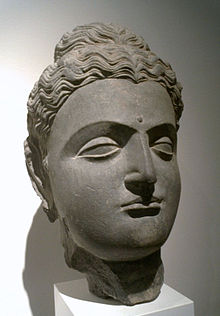
Buddha Statues from Gandhara


·         Basic Buddhism Guide from BuddhaNet 
·         BuddhaNet article about Buddha’s First Sermon at Sarnath
·         Life of the Buddha essay at the Metropolitan Museum of Art
·         Article on Greco-Buddhist art at Wikipedia
·         Another Gandhara period frieze of the First Sermon at the Met


Daily Schedule for Weeks 4 & 5

Week 4:  Representations of the Buddha 

M:  Gandhara Buddha (1-10) and Buddhist Iconography
W: Buddhas from Mathura (1-12), Sarnath (1-15) Sukothai (2-11), 
F:  Buddhas from China (3-11; 3-14), Tibet, Japan + First Exercise DUE

Week 5: Buddhist Temples: from stupa to pagoda
M:  Great Stupa at Sanchi (1-7)

W: Chaitya Hall, Karle; Borobadur;
Schwedagon Pagoda (2-13)
F: 
Fougang Si Pagoda (3-23); and maybe Horyuji Temple Complex (5-9)

Week 6: Hindu Deities -- esp. Shiva