Friday, March 4, 2011

Chinese Calligraphy

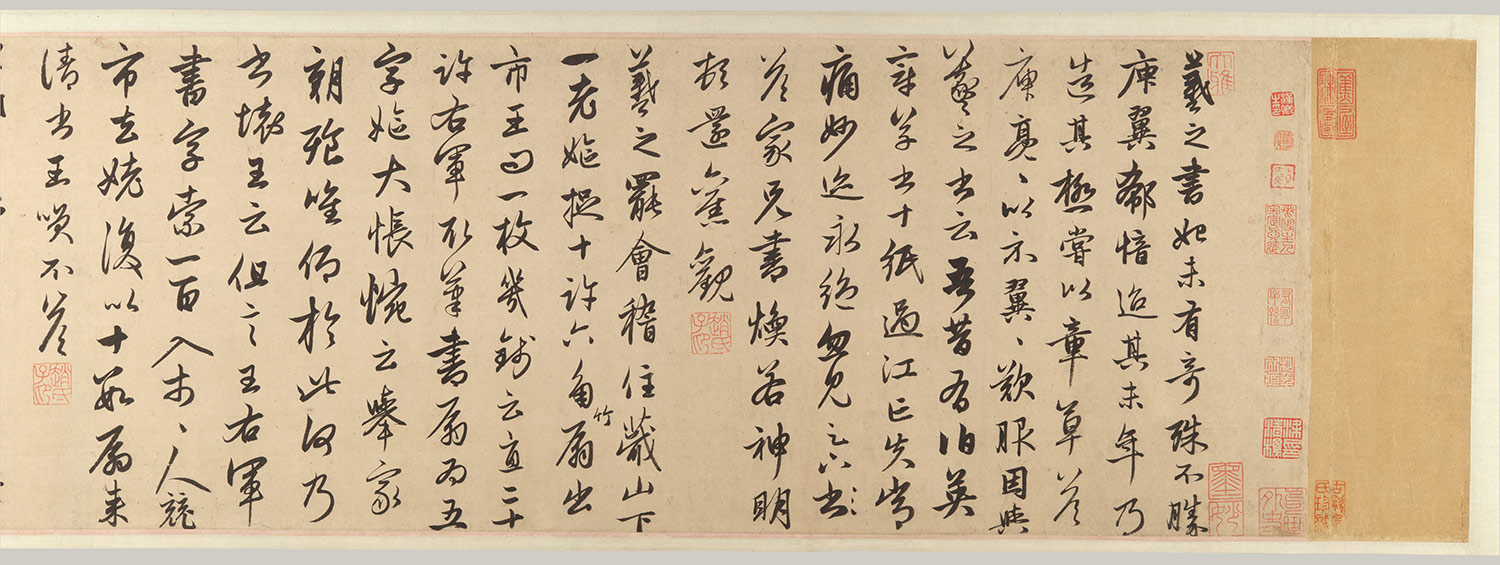
Four Anecdotes from the Life of Wang Xizhi, ca. 1310
Zhao Mengfu (Chinese, 1254–1322)

Source:Zhao Mengfu: Four Anecdotes from the Life of Wang Xizhi (1989.363.30) | Heilbrunn Timeline of Art History | The Metropolitan Museum of Art

Chinese Character Classification -- at Wikipedia
Chinese Calligraphy -- Timeline of Art History
China's Calligraphic Arts -- at the Freer/Sackler

Two videos that demonstrate basics in Chinese calligraphy.


The videos below are properly Japanese rather than Chinese, but the principles still apply.  The first begins a series on calligraphy by discussing brushes.  The second is a lengthy but excellent demonstration of calligraphy in several styles.  


Tuesday, March 1, 2011

Chinese art: purposes, patrons, and public

"Art served several purposes in China, functioning as magical objects, emblems of authority, signs of superior cultural refinement, mechanisms for the preservation of information, and vehicles for self-expression.  As the worlds first art historian, Zhang Yan Yuan (847), stated succinctly, art helped human relations and explored the mysteries of the universe.  Art, he wrote, completes culture.  Patrons included members of the imperial court, noble families, high-ranking bureaucrats, and Buddhist and Daoist monasteries.  However, the percentage of the population having access to visual imagery was small, not to mention the miniscule number of people who commissioned or owned works of art."  
--- Mackenzie, Lynn.  Non-Western Art: A Brief Guide.  2nd edn.  Upper Saddle River, NJ:  Prentice-Hall, 2001.  (86)

Monday, February 28, 2011

Chinese Jades, Bronzes, Ceramics

    So much material, so little time . . . please, browse your way through some of these resources.  We'll primarily discuss Chinese jade bi discs and the Ming dynasty vases known as the David vases, both shown below.

bi discs at the Freer/Sackler


Chinese Dynasty Guide (Minneapolis Institute of Arts)
China page at The Asia Society's webpage -- links to many specific subject pages
China page at the Freer/Sackler museum
Ancient Chinese Jades and Bronzes (Freer/Sackler)
Chinese Jades: bi (Freer/Sackler)
bi Disk with Dragons (Nelson-Atkins) [3-5]

Guide to Chinese Ceramics (Minneapolis Institute of Arts)
Page on the Chinese Ceramics in Room 95 at the British Museum
Percival David Foundation Collection
The David Vases (British Museum)

 
The David vases

Schedule: Weeks 7 & 8

Week 7:  Chinese art I: concepts & materials

M:  First Emperor's Tomb (3-6) 
W:  Chinese jades (3-5)  and ceramics (4-5)
F:   Chinese calligraphy

SPRING BREAK

Week 8: Chinese art II: landscape painting

Sunday, February 27, 2011

Monday, February 21, 2011

Hindu Temples

Mammallapuram (Mahabalipuram) temples
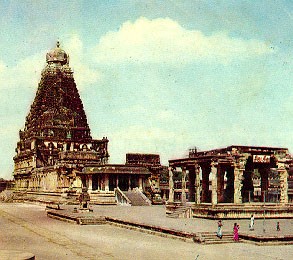
Rajararajeshvara Temple (also known as the Brihadishwara Temple) at Thanjavur
Kandariya Mahadeva temple

Room Change this Wednesday !!

Hi Warren,

I just wanted to send you a reminder that due to the Admissions Open House, we need you to hold your 9:05 class on Wednesday, February 23rd in Coleman B instead of McDonald.  Francine Varisco’s class will be on a field trip and shouldn’t be in the room that day J Please let me know if you have questions or problems.  Thank you! 

Sally

Friday, February 18, 2011

Shiva 1

Shiva Trimurti (Elephanta)


Shiva Mahayogi (Bangalore)


Broad Background:  A good overview of Hinduism at Wikipedia
Details: Wikipedia’s page on Shiva
360 Image:  Shiva Trimurti at the Elephanta Cave Temple, Mumbai 
Wikipedia entry on the Shiva Temple at the Elephanta Caves, Mumbai
Video for Children that describes Shiva & tells some important stories

Daily Schedule for Weeks 6 & 7

Week 6:  representations of Hindu deities: Shiva / Hindu temples

M:  Shiva 1: Shiva as lingam & as Mahadeva (Elephanta temple [1-18]) 
W:  Hindu temple: concepts & forms: (1-22 & 1-24)
F:  
Shiva 2: Shiva Nataraja (1-25)

Week 7:  Chinese art I: concepts & materials

M:  First Emperor's Tomb (3-6) 
W:  Chinese bronzes (3-3) & jades (3-5)  
F:   Chinese 
textiles (3-7) and ceramics (4-5)

SPRING BREAK 

Week 8: Chinese Landscape Painting 

Wednesday, February 16, 2011

Stupa to Pagoda 5: Fogang Si Pagoda (3-23)

Useful cultural background:  The Song Dynasty in China (Columbia University) LINK
Wikipedia article: Pagoda LINK
Wikipedia article: Architecture of the Song Dynasty: LINK
Wikipedia article: Pagoda of Fogong Temple LINK
Wikipedia article: Ancient Chinese Wooden Architecture LINK
"The Eight-Sided Pagoda of Foguang Si at Yingxian" by Kate Erickson LINK
Some Photos at Flickr HERE and HERE
Wikimedia page: Pagodas in China LINK


Tuesday, February 15, 2011

Stupa to Pagoda 4: Borobadur (1-27) and Shwedagon Pagoda (2-13)

This work sort of bridges the gap between the original stupa form and the more famous pagoda forms of China and Japan.

First, Borobadur, in Java, is the largest Buddhist temple in the world.


Second, the Swchwedagon Pagoda in Yangon, Myanmar -- a lavish building covered in gold and diamonds. I'm disappointed to find that the official pages for the Schwedagon Pagoda are all currently 404 -- you'll have to make do with these:

Monday, February 14, 2011

Stupa to Pagoda 3: Chaitya Hall at Karle (cf. 1-14)


Halls like this one at Karle and the ones at Ellora and Ajanta are carved out of hillsides.  All the interior elements are integral to the cave -- meaning that they are not built separately and set into the cave, but entirely carved out of the living rock.  The hall leads back to a stupa.

overview notes of the period from the Dept. of Architecture at UC Berkeley
descriptive entry at Chaitya.com
entry at Great Buildings Online


Stupa to Pagoda 2: More About Stupas


Miniature Stupa (Ashmolean Museum)


Miniature Japanese Stupas (British Museum)


Thursday, February 10, 2011

Yet More Buddhas beyond India (examples in textbook)

(2-11) Walking Buddha
Sukhothai, Thailand
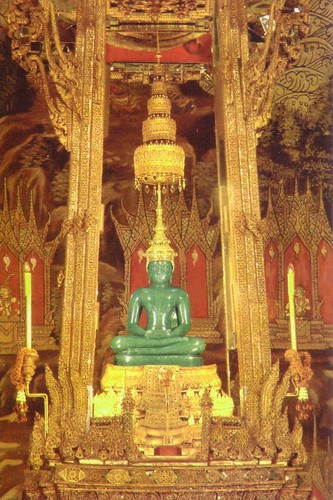
(2-12) Emerald Buddha
Wat Phra Kaew
Bangkok, Thailand
(3-28) Shakyamuni Buddha
Sokkuram, Korea

(3-11) Shakyamui Buddha
Hebei China, Zhao dynasty

More Buddhas beyond India

Buddha (Tibet, 1700-1800)
  
OK, so we've looked at early representations of the Buddha (from Gandhara) and we've looked at a later example (from Sarnath) which shows the early form refined into a classic formula.  Now it's time to consider how that classic formula gets taken up & refined by different cultures, outside India.  


Buddha (Korea, AD 900-1100)
We should keep in mind that, while the Buddha is in some sense a representation of an abstract ideal, the Buddha is also a specific material subject.  In Africa we looked at how different cultures portrayed similar abstract ideals (kingship, power, the relationship between men and women, the ideal child) but always through subject matter that varied from specific culture to specific culture.  The Buddha is a subject matter than can "belong" to any people.  The Buddha crosses all boundaries.   

Buddha (Thailand, 14th c.)
 The Buddha is not just art from the world; the Buddha is art of the world.  There are many peoples, many forms of Buddhas, many styles of Buddhas, many Buddhas, but at the same time, all Buddhas are one.


Article on "Buddhism and Buddhist Art" at the Metropolitan Museum of Art
Article on "The Art of Buddhism" at the Smithsonian Institution
Some different examples of Buddhas
A Chinese Buddha (late 7th-early 8th century)
Another Chinese Buddha (7th century)
A Tibetan Seated Buddha (9th-10th century)
A Buddha from China (early 11th century)
A Buddha from Thailand (16th century)
The Emerald Buddha in Bangkok
A Sukhothai Walking Buddha
Many Buddhas in Baltimore
Perfection in the proportions of a Buddha (BuddhaNet)

Tuesday, February 8, 2011

Another Teaching Buddha from Sarnath

From the British Museum, London.  Photos by yrs truly.


Teaching Buddha from Sarnath (1-13)


Note the lakshanas seen here:
- the urna or dot between the eyebrows
- the ushnisha or cranial bump
- the mudra or hand position (here, teaching the wheel of dharma)
- elongated ears
- simple monk's robe
- the asana or posture (here, meditating)
- lotus seat (here the folds of his robe & not an actual lotus)
- wheel symbols on feet
- halo behind the head


(not all these features appear in all Buddhas or in the same way)


Other Resources:

Friday, February 4, 2011

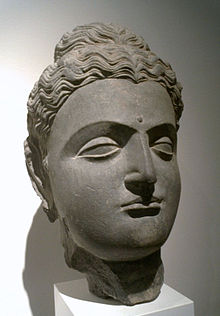
Buddha Statues from Gandhara


·         Basic Buddhism Guide from BuddhaNet 
·         BuddhaNet article about Buddha’s First Sermon at Sarnath
·         Life of the Buddha essay at the Metropolitan Museum of Art
·         Article on Greco-Buddhist art at Wikipedia
·         Another Gandhara period frieze of the First Sermon at the Met